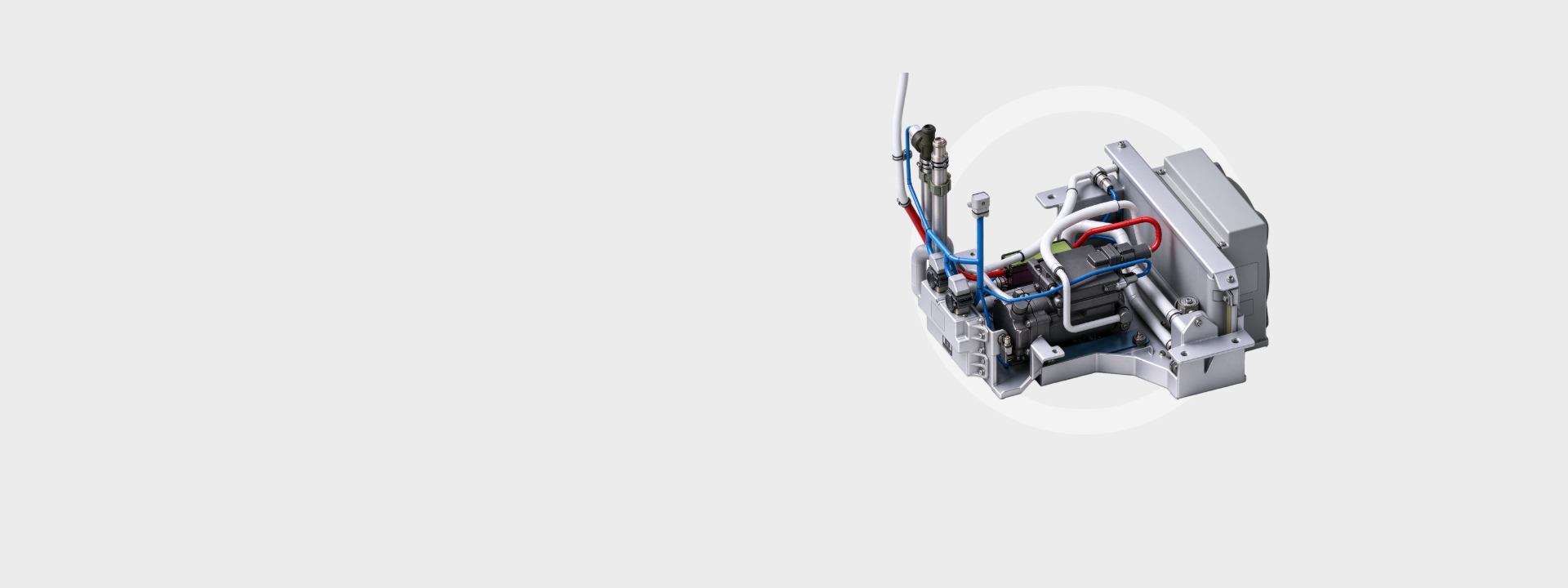
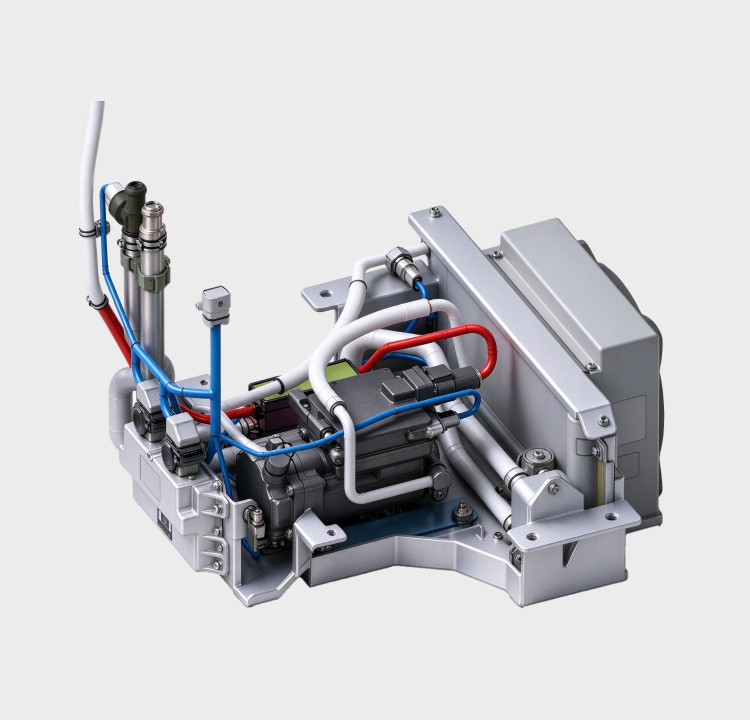
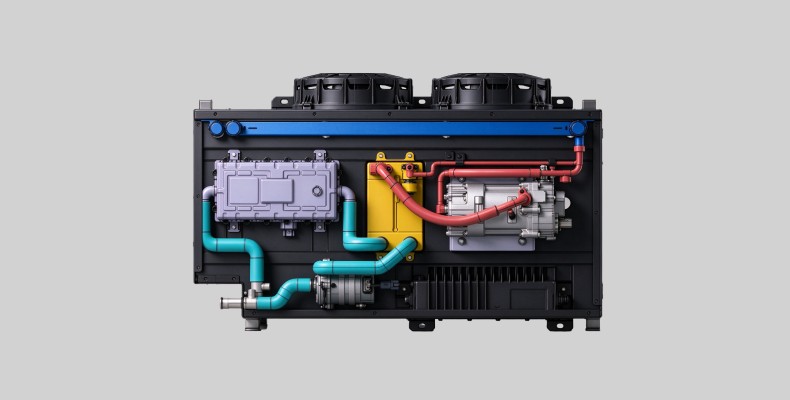
The thermal management system for mobile charging stations consists of core components including a compressor, condenser fan assembly, chiller + EXV assembly, electronic water pump, water heating PTC, as well as associated pipelines and brackets. It can provide about 3 kW of cooling or heating power, meeting the thermal management requirements for most mobile charging scenarios.
Small size, light weight, compact layout, easy to install.
Integrated Features ,achieving both cooling and heating with a single unit
TMS controls the operating mode and water temperature, making it energy-efficient and stable.
The cooling capacity reaches 2.4 kW, heating capacity reaches 2.7 kW, meeting most usage scenarios requirements.
Performance and interface compatible with major customer.
Parts use laser marking and the modules use separate labels, double tracing for better traceability
TMS for Mobile Power Station is core component of the essential components of mobile charging devices. The control unit communicates via CAN with the BMS of the battery requiring temperature regulation (e.g., Mobile charging cart) to exchange demand signals. By adjusting the temperature of the coolant entering the battery pack, the TMS can rapidly meet the cooling or heating requirements of the battery modules whose temperature needs to be controlled.
TMS for Mobile Power Station consists of three circuits: the coolant circuit, the refrigerant circuit, and the air circuit. The core cooling principle of the module is to transfer the heat inside the battery pack via the coolant. The coolant then undergoes heat exchange with the subcooled refrigerant in the refrigerant circuit at the plate heat exchanger, transferring the coolant's heat to the refrigerant in the refrigerant circuit. After cooling, the coolant circulates back into the battery pack to absorb heat again. Finally, the heat-absorbed refrigerant releases heat to the air at the condenser, and the cooled refrigerant returns to the compressor to enter the next reverse Rankine cycle. The heating principle involves using water-heated PTC to directly heat the coolant, which then enters the battery pack to warm the battery, after which it flows back into the PTC for the next cycle.
Customized to customer choice of connection system.
Custom packaging can be provided to meet any need, please contact KESENS Engineering for details.
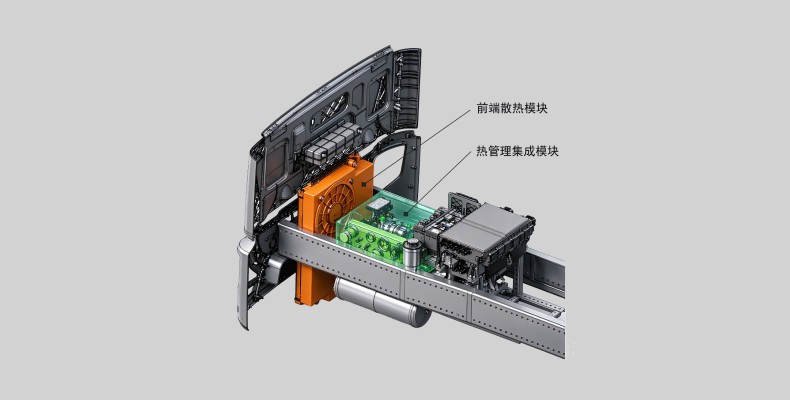

-
Tel: 0573-82858999Fax: 0573-82672893
-
KESENS Power Technology (Jiaxing) Co., Ltd.Email: info@kesens.comAddress: No. 199, Tianshu Road, Economic and Technological Development Zone, Jiaxing City, Zhejiang Province,China.
-