
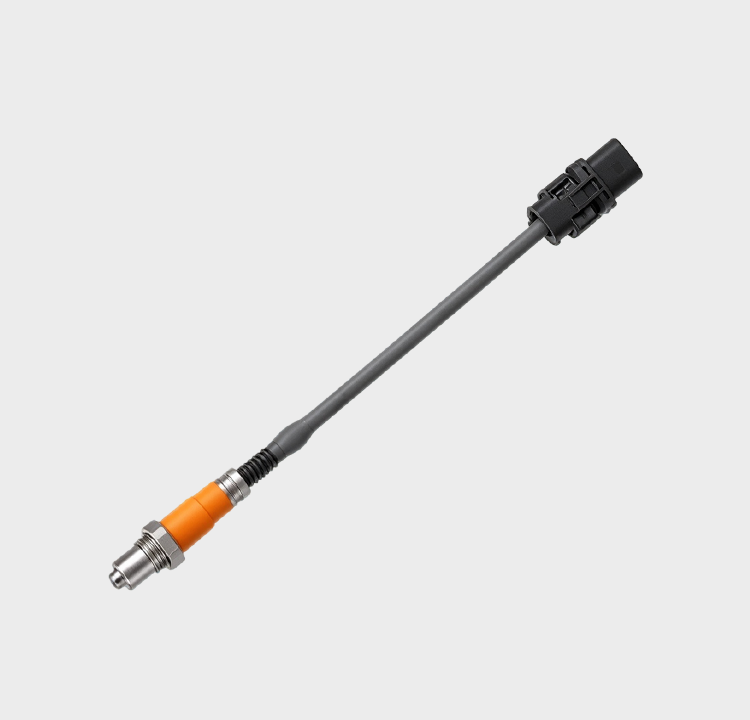
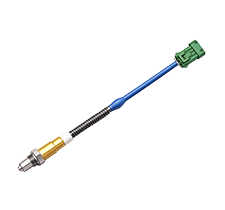
The oxygen sensor for automobile was used to monitor the oxygen concentration in the engine exhaust gas。the engine can Precisely control the amount of fuel injection through output signals (voltage signals or current signals) fed back by ECU and keeping the engine in the optimal combustion state at all times. When combined with the three-way catalytic converter, it can effectively reduce more than 80% of the harmful components in vehicle exhaust, saving 5% to 20% of fuel.
Mounting bolt size: M18X1.5-6e; Hexagonal opposite side size: 22mm;
Application: lambda 0.65 to ∞;
Installation torque: 40~60 NM;
Normal operating temperature range:350℃ ~ 850℃;
Good reliability,Short ignition time, stable output signal;
Strong anti-poisoning ability
Good sealing performance, fast response speed;
Appearance and customer interface can be compatible with mainstream OEM products;
The oxygen sensor is incorporated into the configuration system of modern engine management systems to detect the oxygen content in the combustion exhaust gas emitted by the engine. It then transmits signals back to the ECU, enabling the fuel management subsystem to more precisely control and adjust the air-fuel mixture ratio under various operating conditions of the engine; and in most operating conditions, it keeps the system in an ideal air-fuel ratio working state, so as to achieve better emission control characteristics and fuel economy.
This product is a wide-range λ sensor, which is a ZrO2 dual-battery current-limiting sensor with an integrated heater. It is used to measure the oxygen content and λ value of the exhaust gas. By using a thermal shock protection layer (TSP), the sensor has higher robustness against condensation water on the exhaust side.
The wide-range sensor applies voltage to the pump battery, generating pump current, which keeps the oxygen content on both sides of the oxygen concentration difference cell consistent, maintaining the voltage at 0.45V (i.e., the reference voltage is 0.45V). Rich fuel-rich mixed gas will cause the voltage of the oxygen concentration difference cell to be greater than 0.45V. The sensor controller then applies a negative-direction pump current Ip to pump oxygen into the diffusion chamber for a chemical reaction, reducing the concentration of the exhaust gas and restoring the voltage to 0.45V; conversely, if the rich oxygen-lean mixed gas causes the voltage of the oxygen concentration difference cell to be less than 0.45V, a positive-direction pump current Ip is generated to pump oxygen out of the diffusion chamber. When the fuel or oxygen is neutralized, the output voltage of the oxygen concentration difference cell remains at 0.45V. The wide-range oxygen sensor reflects the concentration or leanness of the exhaust gas, as well as the degree of concentration or leanness, through the magnitude and direction of the pump current.
Customized to customer choice of connection system.
Custom packaging can be provided to meet any need, please contact KESENS Engineering for details.

-
Tel: 0573-82858999Fax: 0573-82672893
-
KESENS Power Technology (Jiaxing) Co., Ltd.Email: info@kesens.comAddress: No. 199, Tianshu Road, Economic and Technological Development Zone, Jiaxing City, Zhejiang Province,China.
-